- - Sigwarth
Menu principal :
Copyright 2020 Alain Chaignon
POLICY:
Introduction:
The principle of the essay that follows is simple,
I took this book by Leo Strauss as close to the questions
that the logic of our earthly situation -
This is the strangeness of my approach.
I don't start from the "humanities" but from a technical fact I found,
from which I trace back to theoretical issues.
Hence the underlying complex due to the accumulation of philosophical answers
which my generation has been saturated with and needs to get rid of, to criticize,
a platform for young speakers who will denounce how these so-
untie the intello-
Crossing Historicism and the classics of political philosophy, with Leo Strauss,
while being Hobbes-
Locke's caution interweaving rationality and God's approach.
I reach, but only with the lived experience of Gallicanism,
Burke's design, but reinterpreted.
The techno-
which is his hypothetical-
Post-
Transposed from Monique Nathan's translation of "Natural Law and History" by Leo Strauss translation destroyed by me to result in the essential on February 19, 2020.
Leo Strauss' introduction is so direct by historicism in "Natural Law and History"
that I've been trying to place him in the field of political philosophical authors.
But combinatorics is multi-
not reducible to a plane projection.
So we have to choose a section.
Now this book recapitulates the past to guide us
From the introduction of "Natural Law and History"
Leo Strauss gets to the heart of the matter in my view.
"The teleological conception of the universe,
of which the teleological conception of human being is part,
"could appear to be ruined by the development of
"modern natural sciences...
"Two opposite conclusions can be drawn.
Already here, the teleological conception of human being is not drawn from the universe but from human being.
"According to the former,
"the non-
"lead to a non-
"This "naturalist" conclusion of human life...
"is open to serious difficulties.
"It is impossible to justify human ends...
"considering them as mere consequences
"of desires and instincts.
"That is why the other conclusion prevailed.
"It was made advisable
"typically modern, where
"non-
"and teleological human sciences are opposed .
"Dilemma in which we are struggling.
Without the slightest suspicion that the solution would come from technology itself, which they all disdained.
My conclusion is: from the universe, probable to demonstrate and
to be distinguished from the earthly world and from Man, that's for sure,
distinguishing in addition the hydrosphere from the chthonian.
Leo Strauss concludes
"Today's social sciences are rejecting
"natural law on two counts:
"They reject natural law in the name of History...
"and they reject it in the name of difference...
"between Facts and Values." (page 184)
A fascinating argument for specialists on the principles and themes of Historicism follows
which I place at the end (page 184) to enter here into the lively logic of the subject that will give content to Historicism in which Leo Strauss goes back to the foundations of the various theories.
I suppose that the reader has read the note on "losingEarth" by Mr. RICH followed by
"Address to a Researcher"
I note here a few compensatory remarks.
Individuality scale:
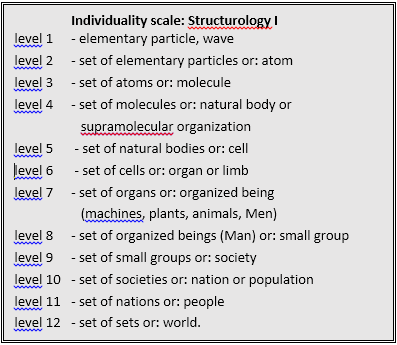
Scale of forms, of contents, of psyches, of Jacob
Structurology and the Right:
Remaining impatient to learn what is right, how would Structurology analyze it?
Basically, before the scale of individualities,
does Right have a psychic function of its own or
is it a complex value of the four PAID functions.
Let's look at the four cases. Can we say:
P -
A -
I -
D -
P is obvious, A doubtful, I suspect, D?
The righteous would be with a P-
subdominant D, differential for the Common Good.
But this borders on dogmatism that the intuitive persons will reject.
Moreover the right includes several levels, from the individual to the right of groups, societies and global Common Good.
Thus we see emerging the circularity of any Value, far from the One that our civilization is looking for.
This will make a reading with a more critical eye of the modern following .