- - Sigwarth
Menu principal :
INAUGURAL COURSE :
Nomenclature
In short, you all have an acquired and intuitive knowledge of these fundamental structures. To facilitate their notation, I have adopted the following conventional writing: (pronounced "psykal, psykel")
Material Structures Psykhell Structures
Ms static Es
Md dynamic Ed
Mc causal Ec
Mt Mutal Et
Individualities scale:
As soon as I wanted to construct a grid of the relations of these fundamental structures, the need to associate a scale of individualities with them, became obvious, in order to order their disorder and to be clear.
I sketched out their 12 levels hereafter:
-
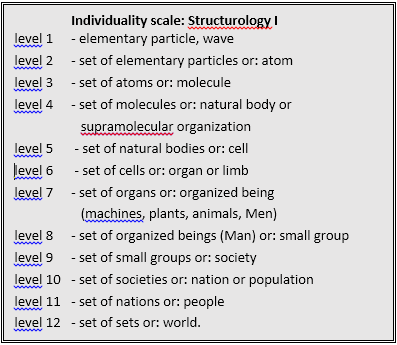
Scale of forms, of contents, of psyches, of Jacob
Under the pressure of a first application, in appendix,
this scale has undergone a doubling mutation to arrive at the one handed out to you in the amphitheatre.
Of course we can decimate this scale, one day redefine it in a congress, but this is enough already to begin and assimilate first that:
at each of these levels appear emerging properties, neither known nor predictable, called new "virtues"; systemic levels of Hayeck, Prigogine.
Scientific observations are needed, waiting for the unexpected or even induced structurological analogy, in order to identify its specific phenomenology.
Does the structure bring out the properties of the “existing”, hence
"There are more properties in a structure than in its components"
or does it filter them out, with their possibilities? It's double-
But on the other hand, and this is the radical divergence of the structurological and scientific approach: we project this scale on any subject addressed, whereas science isolates its concepts as much as possible.
*
STRUCTUROLOGY OF THE INTELLECT FUNCTION
A traduire du français par un linguiste anglais.
Faced with the excessive confusion of the function Intellect with Reason, it became necessary to go around the lexical field in "philosophical notions"...
Let us distinguish the original Intellect,
vague, going from Reason to the least rational of Intellect,
this out of the Imagination (I -
and out of Desire (A -
that societies and governments must balance.
The following are then distinguished as phases of Intellect :
The Statics of Intellect
-
The Dynamics of Intellect
Lessons, classes, hearing one's civilization, integrating it...
Then all true or false communications
Causal Thinking
The Demonstrative Logic, leading to Evidence
then rhetoric, sermon to convince (P)
to be distinguished from rhetoric to please (A).
Mutal Thinking
That of the great changes of mind, revelations, revolutionary ideas...
All this to be combined with the scale of individualities
This development leads to the succession of
small matrices of 256 intelligible. (Book III)
*
phenomenology of evidence:
You follow a course, not only are you taught dynamically, but, here, you are shown, for example, the evidence of a theorem of geometry, or of a law of physics, or even a biological or an economic one.
This law is established by a demonstration; a demonstration during which we construct theme by theme in our mind,
let's take a straight line... draw a parallel... raise a perpendicular... etc.
Is built in your mind a structure which, at the moment the last theme is put in place,
triggers a flash of evidence in your mind:
the square of the hypotenuse is equal to the sum of the squares of the other two sides...
Observe how the phenomenon is discontinuous!
So much so that there is even a state of reversible transition where, with a theme that disappears and returns,
at the frontiers of memory, the evidence itself disappears and returns.
And often one seeks this rebellious theme from classmates, a colleague at work, or in feverish rereading, research. (rumor of acquiescence in the lecture hall).
The connection of the evidence with the structure appears even so remarkable that as long as a theme is not in place,
until the form is closed, the evidence does not appear.
We're in a blurry state, we can't see. (deep, approving sighs).
All the elements must be structured in a certain order for the evidence to burst forth.
We have a mutual structure here.
This is the case for all structured demonstrations, reasoning and judgments.
Our advantage is the simplicity of our structures. For the literary persons there is a multiplicity of diffuse interweaving,
with the anguish of not closing the book, either because of the suspense of the novel or because of the complexity of reality,
so they talk about transcendence.
There is no transcendence of scientific evidence,
it is psychic content linked to a physical structure.
It is this universal link that is transcendent...